

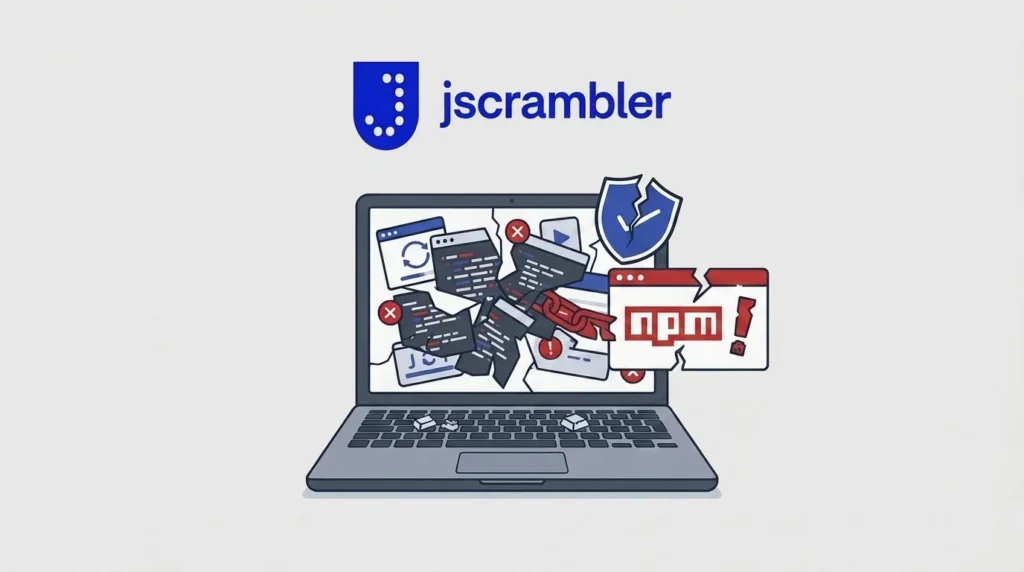
The official jscrambler npm package was compromised across at least five versions beginning with 8.14.0. Any developer who installed or upgraded to an affected version pulled down a Rust-written infostealer during the npm installation process itself before writing a single line of code.
The Hacker News first reported the compromise. According to their coverage, the infostealer targets cloud provider credentials, cryptocurrency wallets, browser-stored logins and credentials stored by AI coding tools. The combination is not accidental. Developers running jscrambler professionally are precisely the accounts that hold AWS, Azure and GCP access keys alongside the kind of local credential stores that make lateral movement into a build pipeline straightforward.
Remove every affected version from your environment before reading the rest of this article.
Five Versions, Not One
Initial reporting focused on 8.14.0. The Hacker News subsequently confirmed the compromise extended across five versions, linking the additional affected releases to analysis by Socket. The exact upper boundary of the affected range had not been independently confirmed by a government advisory at the time of writing and the CVE entries assigned to this incident including CVE-2026-13778, CVE-2026-13795, CVE-2026-13809, CVE-2026-13842, CVE-2026-14096, CVE-2026-14396, CVE-2026-14399, CVE-2026-14404, CVE-2026-14423, CVE-2026-14428, CVE-2026-15308, CVE-2026-58281 and CVE-2026-59871, do not yet carry published CVSS scores in the NIST National Vulnerability Database. Thirteen CVEs across five package versions suggests the malicious code was not a single payload dropped once. Treat every version between 8.14.0 and 8.16.0 as suspect until Jscrambler publishes a clean boundary with a cryptographic verification method.
The attack vector here is worth being precise about. The infostealer is not delivered through a vulnerability in jscrambler’s obfuscation logic. It runs during npm install. A developer who types npm install jscrambler on an affected version executes the malicious code on their own machine, under their own user context, before the package does anything it is supposed to do.
What the Infostealer Takes
According to The Hacker News, the Rust infostealer targets four categories of credential storage including cloud provider access keys, cryptocurrency wallets, browser-stored logins and credentials cached by AI coding assistants. The Rust choice is deliberate. Rust binaries are compact, fast and harder to analyse dynamically than Python or JavaScript payloads. They also do not require a runtime interpreter already present on the machine which removes a detection dependency that defenders sometimes rely on.
Cloud keys are the highest-value target in that list. An AWS access key exfiltrated from a developer’s machine does not stop being valid when the developer uninstalls the package. Key rotation is the only remedy and it needs to happen before the attacker uses the key, not after.
The Supply Chain Angle Is Worse Than the Endpoint Risk
Jscrambler is a JavaScript obfuscation and protection tool used in CI/CD pipelines. Developers do not just run it locally. Many organisations install it as part of an automated build process which means the infostealer may have executed in a build environment with access to secrets stored in pipeline variables not just the individual developer’s credentials.
That distinction matters. A developer workstation holds that developer’s credentials. A compromised CI/CD runner holds every secret the pipeline touches including deployment keys, container registry tokens, signing certificates, API keys for downstream services. The blast radius is determined by what the runner can access, not by what the developer personally stores.
I would be cautious about any organisation that concludes this incident is closed once they uninstall the package. The question is not whether the package is gone. It is what ran during the window when it was present and whether those credentials are still valid.
No Named Nordic Company Has Disclosed Exposure Yet
No Swedish, Norwegian, Finnish or Danish organisation has publicly confirmed exposure to this incident at the time of writing. Jscrambler’s customer base includes enterprise software teams across Europe and any Nordic development shop running automated JavaScript builds should check its dependency logs. The absence of a public disclosure does not mean the absence of a compromised build environment.
Steps Before You Continue Development
Check your package-lock.json, yarn.lock or equivalent lockfile for any jscrambler version between 8.14.0 and 8.16.0 inclusive. If any affected version is present, treat the machine or runner that installed it as potentially compromised.
Rotate cloud credentials immediately. Do not wait to confirm exfiltration. AWS, Azure and GCP all support credential rotation without service interruption if planned properly. Revoke the old keys before the new ones are in place and you have a brief outage. Rotate with overlap, then revoke.
Audit your CI/CD pipeline secrets. If the affected package version ran in a build environment, pull the full list of secrets available to that runner and rotate every one of them. Pipeline secrets are frequently over-provisioned and under-audited. This incident is a reasonable moment to remove any that are no longer actively needed.
Check browser credential stores on any developer machine where the affected version ran. The infostealer targets browser-stored logins directly. Password manager exports should be reviewed for any credential that was accessible in a browser profile on the affected machine during the window the package was installed.
Pin your npm dependencies with exact version locking and enable integrity checking via npm ci rather than npm install in automated pipelines. This does not prevent a compromised upstream package from being installed but it prevents silent upgrades to a compromised version if a developer or pipeline previously had a clean one.
Wait for Jscrambler to publish a signed, verified clean version before resuming use of the package. The company has not issued a public post-incident statement with a verified clean build at the time of writing.
References
- Compromised jscrambler 8.14.0 npm Release Drops Rust Infostealer During Install
- Update – jscrambler npm Compromise Hit Five Versions, Not One
- NIST National Vulnerability Database
This post is also available in:
 Svenska
Related News

Check Point Management Zero-Day Exploited as VPN Attacks Target Spark Firewalls
Check Point customers who installed the 9 September hotfixes closed the VPN flaw attackers began probing three days later. Management servers running those same builds…
 September 25, 2026
Cisco Secure Email Gateway Zero-Day Gives Attackers Root From One Email
September 21, 2026 
Dutch NCSC Expects Mass Exploitation of Two Critical Check Point VPN Flaws
September 14, 2026